
TL;DR
Technical SEO issues often get stuck in the developer backlog because fixing them takes more than identifying the problem. With nodediff, SEOs can give developers copy-pastable fixes instead of another ticket to research and code.
Why technical SEO fixes get stuck in the developer backlog
The SEO audit is done. You know what's wrong. You have all the recommendations sitting in a PDF or spreadsheet. But the work still isn't live. And that's where technical SEO tends to get stuck.
The problem usually isn't finding the issues. It's getting a developer to take each recommendation, figure out what needs to change, research the right implementation, write the code, test it, and finally push it to production.
Your developers already have a backlog full of product work. An SEO ticket that says "add product schema" or "fix canonicals" isn't exactly going to jump to the top of that list.
"The SEO graveyard is full of good strategies... It fails because the plan lived in a Google Doc and died in a Jira ticket." Martin Hayman
The exact problem depends on your team, but the pattern is pretty consistent: SEO finds the problem, and someone else has to do a lot of work before it can actually be fixed.
| Who you are | The implementation bottleneck |
|---|---|
| In-house SEO | Your recommendations get stuck in the engineering backlog behind revenue-driving product features. |
| Agency | You deliver a 100-page audit, but the client never implements it. Traffic stays flat, and eventually they start questioning the value of the engagement. |
| Freelancer / consultant | You can diagnose the problem perfectly, but you don't have access to the client's codebase or a developer who can push the changes live. |
| Small SaaS / startup | The founder or single developer is already overloaded and doesn't have hours to spend figuring out schema documentation. |
How nodediff fixes SEO issues faster
This is the gap nodediff is built to solve. It works page by page, requiring just two simple inputs:
- Your target URL
- The search term you want to rank for
Instead of handing your developer a list of things to research and implement, nodediff does the work behind the recommendation and gives them the actual fix. So your developer doesn't have to spend an afternoon figuring out how to implement a schema recommendation from an SEO audit. They can simply review the generated code, make any changes they need, and ship it.
The goal isn't to remove developers from the process. It's to remove the SEO implementation work that doesn't need to take up their time in the first place.
What nodediff checks for technical SEO issues
When you run an audit in nodediff, we look at two things: what is working in the SERP, and what's happening technically on your page.
1. Competitor SERP analysis
First, we scrape your page and compare it directly against the top 5 Google search results for your target keyword.
- Search intent: How the top-ranking pages approach the topic.
- People also ask (PAA): The exact questions Google associates with the keyword.
- Heading topics: The specific subtopics competitors cover in their H1-H6 tags.
- Word counts: Target lengths based on what is actually ranking, rather than generic industry averages.
- Media usage: How competitors use images and formatting.
- Freshness: The dates and update frequencies of winning content.
This gives you a much more useful starting point than a generic list of SEO recommendations. You can see what the pages currently winning the SERP are doing and where your page falls behind.
We'll compare your page against the top competitors and recommend exact opportunities to close the gap based on what Google is currently rewarding.
2. Technical SEO code checks
Then we check the core technical elements of your page.
- Title tags & meta descriptions
- Robots.txt directives
- Canonical tags
- Hreflang tags
- Internal linking structure
- JSON-LD schema markup
- Heading hierarchy (H1-H6)
- Image alt attributes
- Open Graph & Twitter cards
- HTML code bloat
If something is missing or broken, nodediff doesn't stop at telling you there's an issue. It generates the code needed to fix it.
For example, if a competitor is winning a Featured Snippet because they use semantic lists, we don't just say "Wrap your headings in a list." We give you the exact HTML structure to deploy:
That means the developer gets something they can work with immediately, rather than another research task.
Turning SEO issues into code with nodediff
Think about what normally happens after an audit.
As SEO consultant Lawrence Hitches puts it:
"SEO submits vague tickets, dev doesn't understand the impact, product managers prioritise revenue features, and SEO changes die in the queue." Lawrence Hitches
That's the problem nodediff is trying to remove.
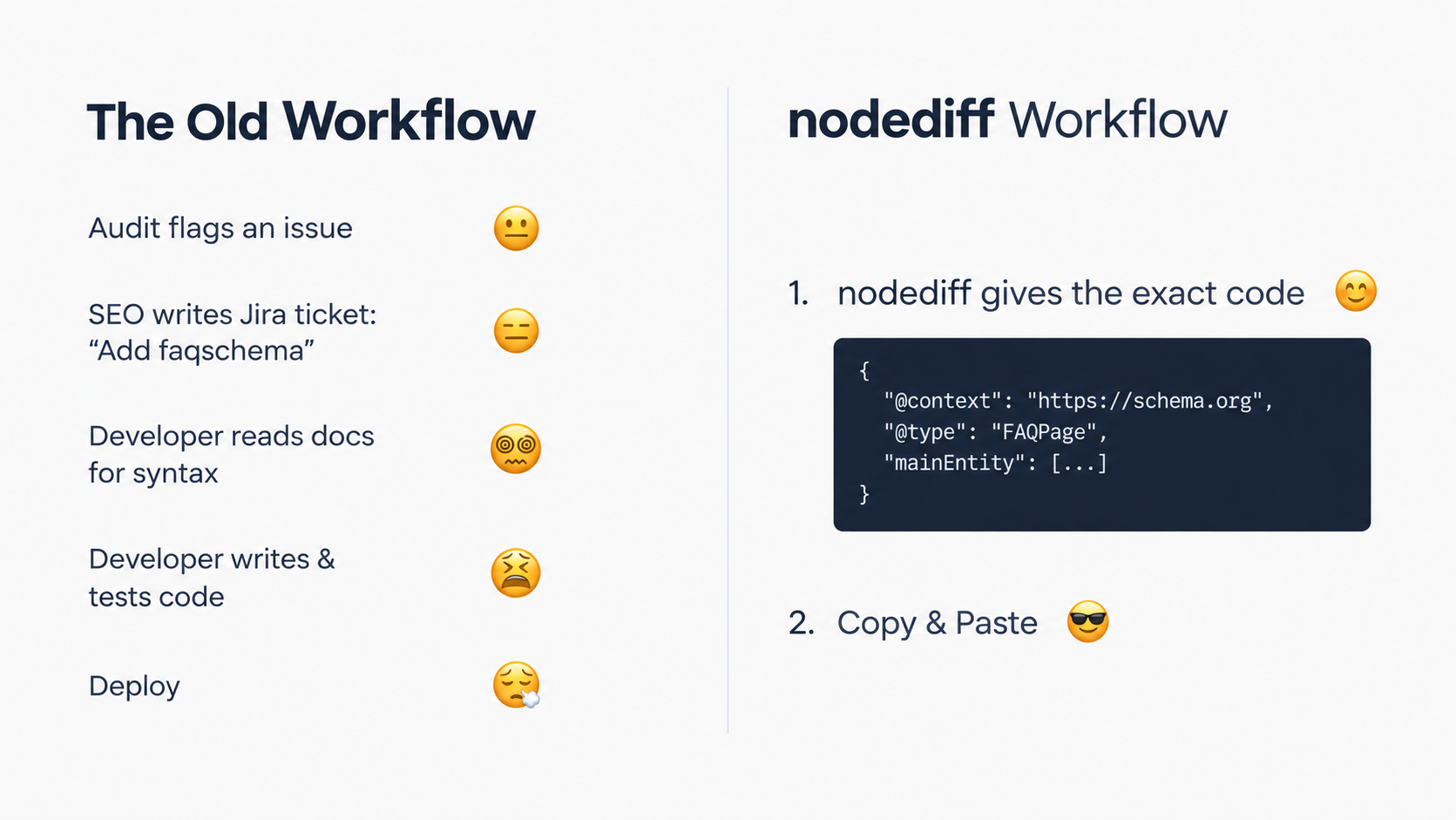
There is nothing wrong with the developer doing the implementation. The problem is making them start from a recommendation and do all the research and coding themselves.
By handing a developer the exact code block, a multi-day sprint ticket can become a 2-minute copy-paste job.
Frequently asked questions
Does this replace the need for a developer completely?
Not necessarily. If the change needs to be made to a hardcoded template, a developer still needs to deploy it. What nodediff removes is the research and coding work in the middle. You can hand the developer the exact code instead of asking them to figure it out from scratch.
Can I implement these fixes myself if I use WordPress or Shopify?
Yes. Most CMS platforms let you inject code into the <head> or make changes through visual editors. Since nodediff gives you the exact JSON-LD or canonical tags, you can often make the change yourself instead of waiting for a developer.
How does nodediff know what to fix?
We live-scrape the top 5 ranking pages for your exact keyword, score your page against them, and use Google Gemini to generate fixes based on what is actually winning in the SERP right now.
How does pricing work?
nodediff is $19/month, which gives you 40 audits that reset monthly. If you run out, you can buy a $10 top-up for 25 extra audits. Top-up credits roll over forever.