
TL;DR
nodediff is a page-level SEO audit tool that compares your page against the top-ranking results for your keyword and provides the exact fix, including code, for every issue found. While traditional tools flag sitewide errors and leave the implementation to you, nodediff pairs every problem with its code-ready solution so you can fix pages and move on.
Sitewide SEO audits leave SEO marketers with more work
We all know Ahrefs and Semrush have largely been about sitewide audits and overall site health. These audits flag problems and leave you to work out the solution and exact fix.
"The easy way, that unfortunately most people do, is running an audit through websites like ahrefs... Then they deliver their customer a report with all links... However that's not a real seo audit in my opinion. To provide your customer value you should show... how they can change it." lordl1quid, r/SEO
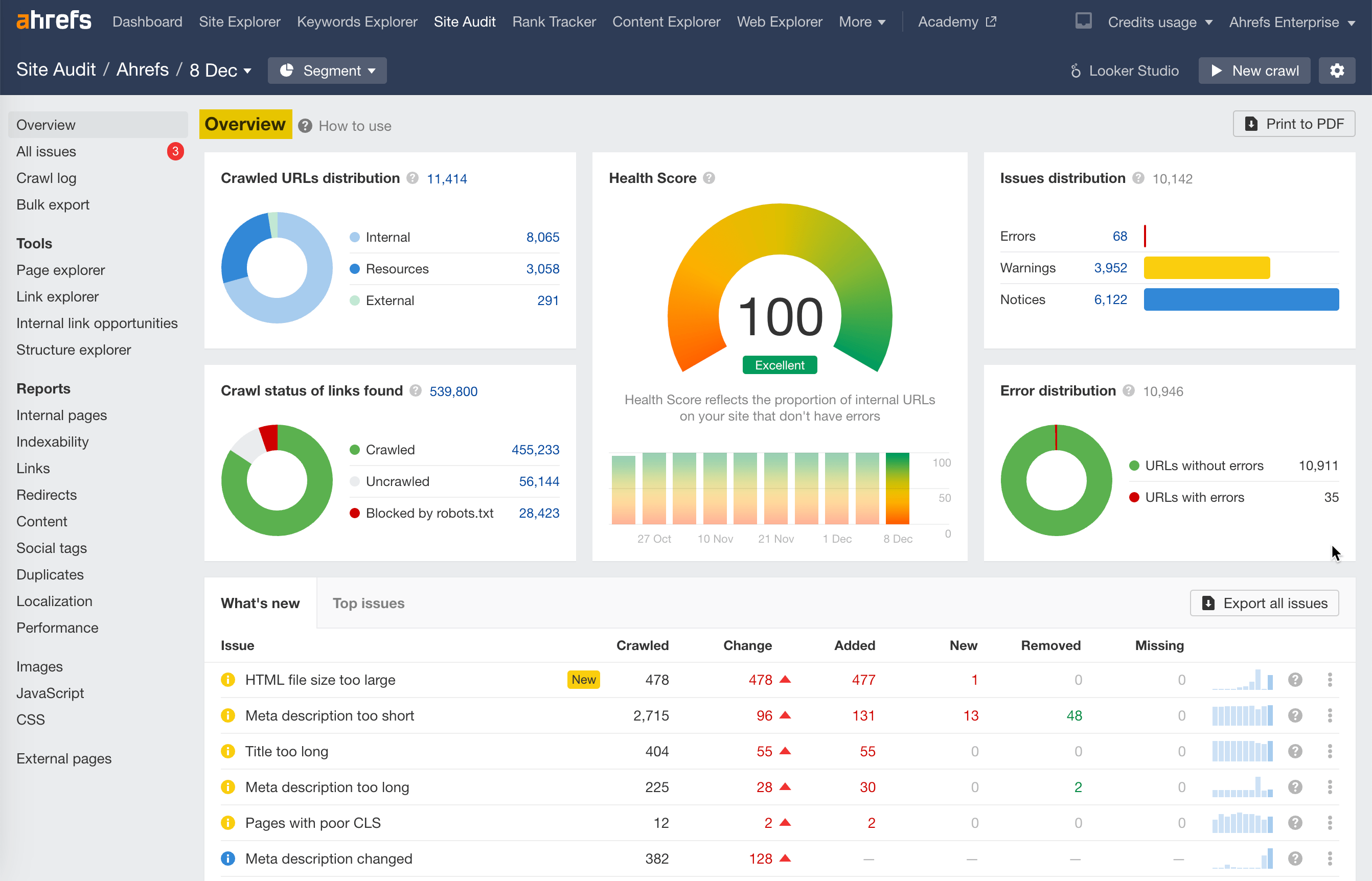
If you're an SEO marketer, you know how difficult it is to make sense of a massive audit. You have hundreds of warnings and errors in front of you, but you still need to figure out what matters, what to solve first, and what can wait. It is easy to get lost in it.
Nobody really talks about the time an SEO marketer has to spend deconstructing a sitewide audit. Finding the issue is one thing. Understanding it, deciding whether it matters for the page you're working on, researching the right implementation, and writing out the fix takes much longer.
That creates a different kind of headache too. You finish the audit, but the work still feels unfinished.
Then you need a developer. Now the SEO work depends on someone else. A developer may need to research SEO-specific schema, metadata, robots rules, or other implementation details before they can make the change. It gets added to a sprint, pushed behind other work, and waits. So the job you completed on paper is still not completed on the live website.
"The SEO graveyard is full of good strategies. Not bad ones. Good ones... Recommendations that would have worked. They just never got implemented. Dev tickets sitting in a backlog for 18 months... The gap between knowing what to do and actually doing it is where most SEO campaigns go to die." Martin Hayman, Co-founder of RankCaddy
The goal should be different. You should be able to pick a page, work through the important problems, fix them, and see that page move from "needs work" to "done."
nodediff is a page-level SEO audit tool that helps you finish the job
nodediff works best for landing pages, blog articles, comparisons, and listicles where you control the HTML. The input is simple: just provide the URL and the search term you're trying to rank for. Instead of starting with thousands of sitewide errors, you start directly with the specific page you want to optimize.
There is no giant list to deconstruct before you can begin. The report is organized section by section, pairing every problem with its exact solution. More importantly, when a finding requires technical changes (like missing E-E-A-T signals or broken JSON-LD), nodediff generates the exact code you need. You can implement it yourself or hand it straight to a developer, completely eliminating the research phase.
By providing ready-to-use code, you can work through the audit without jumping between tools, Google documentation, and developer tickets. Just run it on every page you want to rank, start with your highest priorities, and move on to the next.
nodediff vs. Traditional SEO Tools
The main difference comes down to workflow—traditional tools focus on finding problems sitewide, while nodediff focuses on fixing problems page by page.
| Ahrefs / Semrush | nodediff | |
|---|---|---|
| Main workflow | Sitewide audit and health check | Page-level audit and implementation |
| Input | Website / domain | URL + search term |
| Scope | Entire site | One page at a time |
| Main purpose | Find technical SEO issues | Find and fix issues affecting a page |
| Comparison | Sitewide technical checks | Top-ranking pages for the search term |
| Output | Large list of issues and warnings | Section-by-section problems and fixes |
| Prioritization | You decide what matters for your target page | Focused on the page and search intent |
| Implementation | You research and work out the fix | Fixes are provided with the relevant finding |
| Workflow | Audit → sort → research → ticket → wait → rescan | Audit → understand → fix → move on |
"What am I missing in the workflow resolving site audit issues?... I don't see a button to click to revalidate, only to rescan the entire site audit. Rescanning the whole site between fixes is garbage traffic and load on a server." jwhco, r/SEO
What nodediff checks to help a page rank
The purpose of the audit is to help the page rank for the search term, not just to find technical faults.
nodediff starts by looking at the current search results for your target term. It compares your page against the top five ranking pages and also looks at People Also Ask questions. That gives the audit a much more useful reference point: the pages you're actually competing against.
The report checks things such as:
- Search intent and whether the page matches what people are looking for
- Heading structure
- Content volume and page age
- Semantic gaps between your page and the ranking pages
- People Also Ask topics you may be missing
- Schema and JSON-LD
- robots.txt and other technical SEO elements
- Other page-level differences that can affect how well the page competes
Each area is presented with the problem and what you can do about it. So you can work through the report section by section instead of staring at a wall of warnings and trying to decide where to begin.
View one of our sample reports:
The difference with nodediff is the implementation. When a finding requires code, the report gives you the code you can use. You can implement it yourself or hand it directly to a developer without making them start the SEO research from scratch. The result is a much shorter path from audit to finished work.
"You flip that 'enable' button and suddenly you're staring at a wall of validation errors with no obvious cause... That's exactly the moment you want a developer who can go in, adjust the defaults, and write a bit of custom code." Vukasin Ilic, SEO Specialist
Do you still need Ahrefs or Semrush?
Yes, if you use them for backlink analysis, rank tracking, competitor research, or keyword research. Those are different jobs.
Pricing
- $19/month gets you 40 audits. They reset every month and don't roll over.
- $10 gets you 25 additional audits. These don't expire and stack with other top-ups.
- Monthly audits are used first. Once those are gone, nodediff uses your top-up balance.
Frequently asked questions
What page types does nodediff work best on?
nodediff works best on landing pages, blog articles, comparisons, listicles, and other pages where you have control of the HTML and can make the recommended changes.
What happens when my 40 monthly audits run out?
If you have top-up credits, nodediff uses those next. Otherwise, you can buy 25 additional audits for $10 or wait for your monthly credits to reset.
Do the $10 top-up credits expire?
No. They don't expire and stack when you buy more.
Can I buy more than one top-up in a month?
Yes. There is no limit.